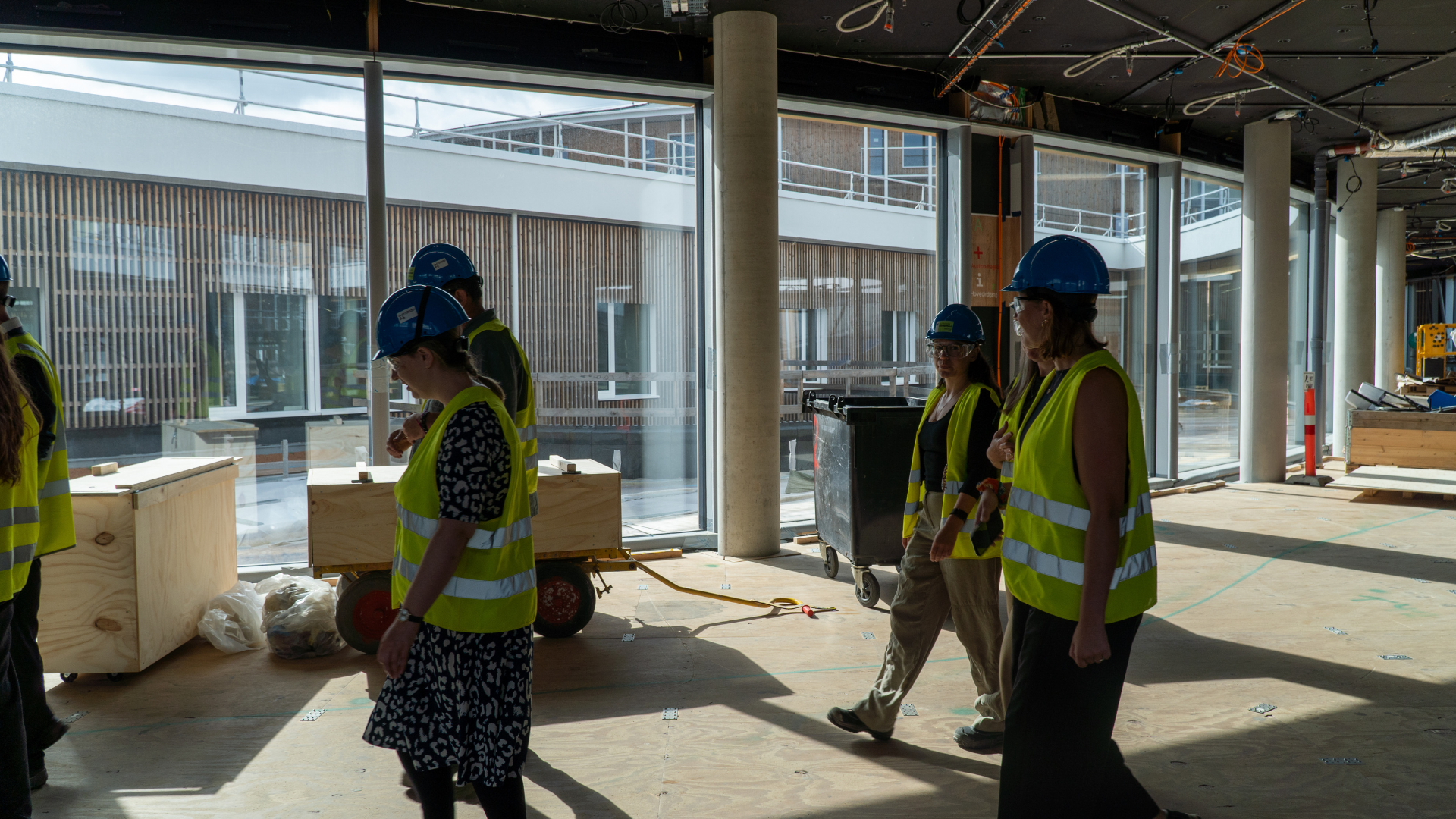
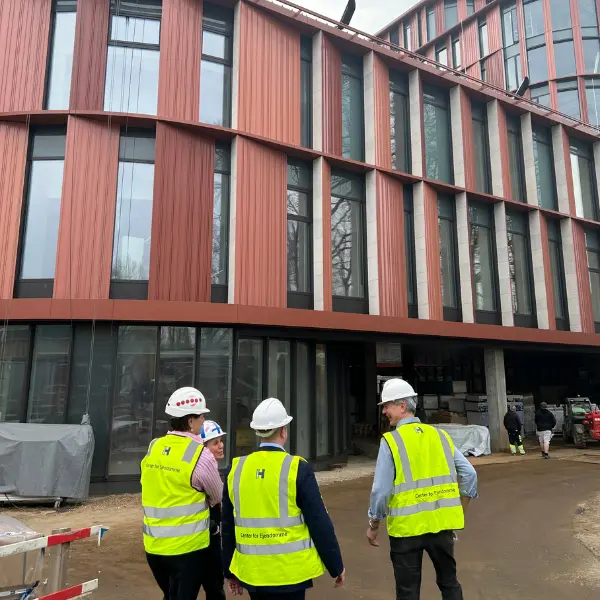
A delegation from Manchester spent two days in Denmark, comparing learnings on digital hospital solutions and integrated single-room care. Denmark has been through the transition, Manchester is now planning, and the visit was an honest exchange about what that experience has taught us, today's challenges and successes included.
England is in the middle of the largest hospital construction effort in a generation. Under the national NHS New Hospital Programme, many hospitals will be rebuilt across the country in the years ahead, with new thinking on everything from layout and single-patient rooms to the digital and smart-building technology that runs underneath it all.
The two countries share the same pressures, too: a growing elderly population, rising demand for services, increasing complexity of care, and the need to make the best use of available resources. That common ground is what brought a delegation from North Manchester General Hospital (NMGH), part of Manchester University NHS Foundation Trust, to Denmark as part of the New Hospital Programme, not to see a finished model to replicate, but to hear openly what has worked, what has not, and why.
"It was incredibly useful to see and hear the latest in Danish hospital design and technology. In particular, seeing the high levels of automation in action has given us real insight into how these new technologies might work in the new North Manchester General Hospital. We appreciated hearing not only what has worked well but also honest insight into the challenges our Danish colleagues have already overcome." - Sophie Hargreaves, Deputy Programme Director and Target Operating Model Lead, NMGH New Hospital Programme.
Denmark has spent the past years building and operating a new generation of hospitals and is still learning as it goes. But Denmark has made the transition, learned from it, and picked up plenty of knowledge along the way that is worth talking through with others facing the same decisions.
Shared questions, two different examples
The conversation ranged widely: how you plan and lay out a hospital for the decades ahead; how digital and smart-building technology gets woven in from day one; how automation and logistics change the way a hospital runs: and how the wider ecosystem of hospitals, research and companies feeds into it all.
The shift to single rooms is one thread running through much of it. Single rooms are better for infection control, for privacy and for patients, but they also create a fundamentally different operational environment, one where clinical staff lose the natural line of sight that open wards provide.
How do you keep oversight when every patient is behind a closed door? That question alone touches staffing models, workflows and the digital tools that support the people on the ward. It is one Denmark has spent years working through and is still refining.
Over two days, the delegation went behind the scenes at two very different examples of Danish hospital building to see how these questions are being worked through in practice.
Day one: smart building and planning principles
The first day centered on New North Zealand Hospital in Hillerød, a hospital designed around three things Manchester is aiming to learn from: standardized, efficient layouts; single-patient rooms; and digital, smart-building technology.
The conversation moved through the planning principles behind the build, how layout, infrastructure and patient flow come together, and what real experience with single rooms means for patient safety, staff workflows and bedside digital solutions.
"What was particularly valuable was seeing the technology operating in day-to-day practice. Rather than looking at concepts or demonstrations, we were able to see how digital solutions support patient flow, logistics and clinical decision-making in a live hospital environment. Those insights are incredibly relevant as we continue developing our plans for North Manchester." - Dean Whitehouse, Estates and Facilities Lead North Manchester General Hospital.
"One of the most valuable aspects of the visit was seeing how hospitals have adapted to delivering care in predominantly single-patient rooms. Single rooms offer clear benefits for privacy, dignity and infection prevention, but they also change how staff work and interact with patients. Seeing how Danish colleagues have addressed those challenges in practice gave us useful insight as we continue planning a hospital that supports both excellent patient care and a positive staff experience." - Jill Findley, Head of Nursing, Urgent and Emergency Care, North Manchester General Hospital.
The afternoon shifted to DTU Skylab's pop-up makerspace at Rigshospitalet, where the delegation looked at the innovation ecosystem behind Danish healthcare, and the close link between hospitals, research, companies and clinical need.
Day two: the digital, technology-enabled hospital
Day two moved to the new Aalborg University Hospital, covering the question: what does a modern hospital look like when the digital solutions are running in daily use?
"What stood out was seeing these design principles implemented at full scale. Being able to walk through the hospital before it opens helped us understand how standardized layouts, single-patient rooms and digital infrastructure come together to support both patient care and staff experience. It gave us practical insight that we can take into our own planning for North Manchester." - David Bailey, Smart Building Lead for North Manchester General Hospital.
Rather than seeing solutions on slide decks, the delegation watched them working in real conditions, supporting patients, staff and workflows inside the hospital. The day spanned digital health and integrated, patient-centered care; the commissioning, automation and logistics behind moving into a brand-new hospital; automated laboratory logistics with sample conveyor systems; and a look ahead to AI and robotics.
A highlight was seeing Columna Flow from Systematic in action, a reminder that a working health system is not rooted in a single hospital or a single company, but in a public–private collaboration that delivers together.
"The parts that work best were built with the clinical teams who use them. Aalborg's staff shaped how Columna Flow works in their own departments, which is why they can stand in front of a visiting delegation and explain it themselves, without us in the room." - Jacob Gade, Sales Director at Systematic.
"The UK and Denmark have a lot to learn from each other.”
The common thread across both days was not a single technology, and it was not a claim that Denmark has it right. It was an approach worth comparing thinking on: solutions developed together with the clinical teams who use them, built around concrete operational needs, and improved with feedback from the start. Something which is hard to see on paper, which is part of why sitting down together is worth more than any slide deck or report.
“The UK and Denmark have a lot to learn from each other. We have similar healthcare systems and share many of the same values. As MFT NHS embarks on a major hospital modernization program, the process of building New Aalborg University Hospital, and the lessons we have learned along the way, can offer relevant insights. At the same time, there is also much Denmark can learn from the UK." - Søren Pihlkjær Hjortshøj, Medical Director at Aalborg Universitetshospital.
Thank you to the delegation, and to New North Zealand Hospital, DTU Skylab, Aalborg University Hospital and Systematic for sharing their perspectives and learnings.
See what they saw during the visit in the gallery below.