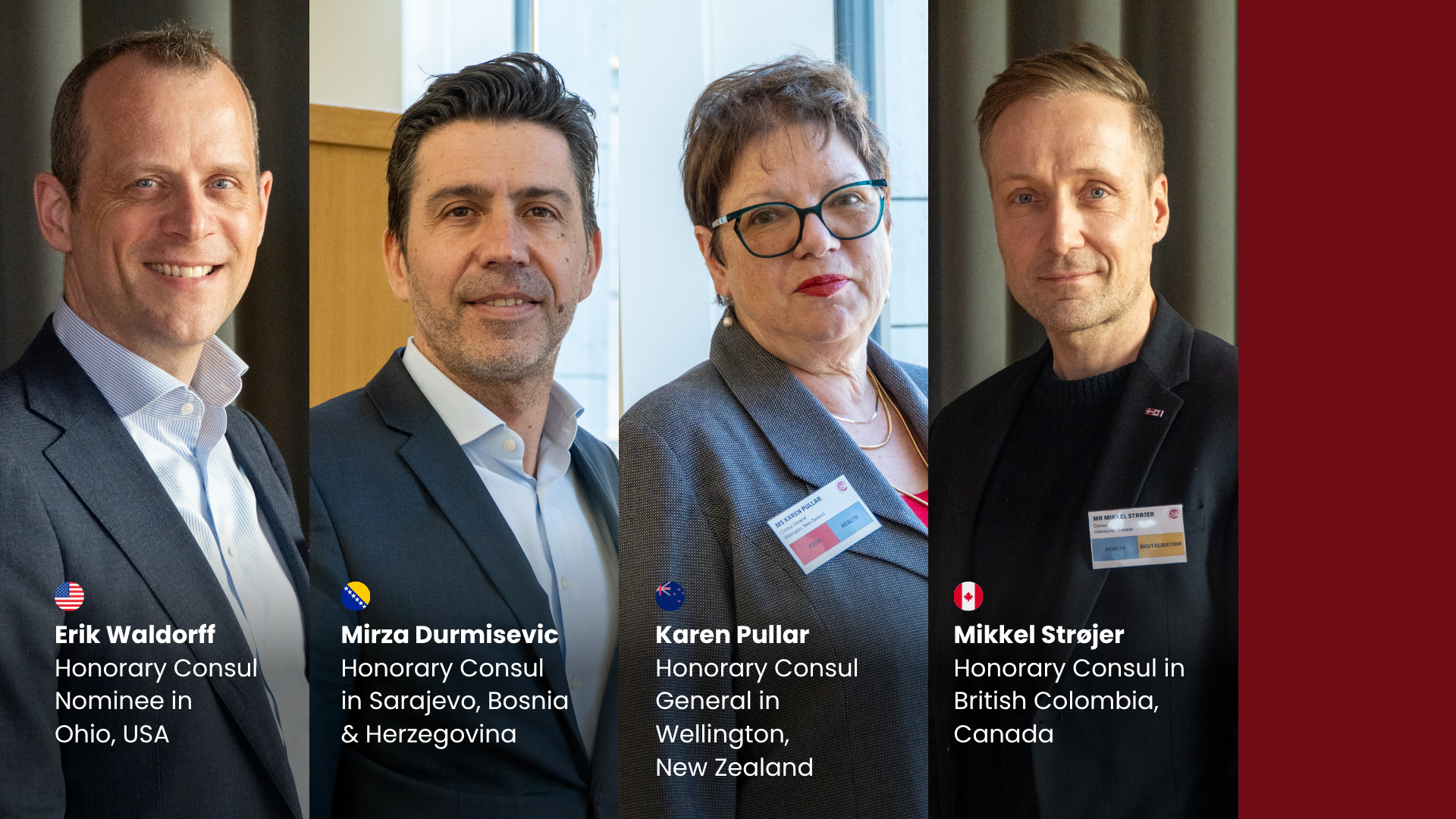
A group of Denmark’s honorary consuls came on visit to learn about the Danish life science ecosystem. From AI and digital health to patient-centered care, it stands out that Danish solutions are not only strong at home - but they are also in demand globally.
From a hospital foundation in Vancouver to a Medtech distributor in Sarajevo, to an audiologist in New Zealand, and to one of the world’s leading medical research institutions in Cleveland, Ohio, four honorary consuls representing Denmark across three continents returned home from Copenhagen with similar impressions.
During their visit, they were introduced to Danish healthcare infrastructure, life science startups, and leading research environments. When asked what stood out most, three themes emerged consistently: the role of AI and Denmark’s new supercomputer Gefion, the human-centered design of the new children’s hospital in Copenhagen, and the strength of Denmark’s healthcare system architecture, from its integrated health data infrastructure to new models that improve access and bring care closer to patients.
"The Future of Healthcare" - AI and the Gefion supercomputer
For Mirza Durmisevic, Honorary Consul of the Danish Royal Consulate in Sarajevo and General Manager at Proma Saravejo, the possibilities enabled by the Gefion supercomputer were a revelation.
"This was an area I had not previously been exposed to," he says. "The integration of artificial intelligence into diagnostic procedures represents the future of healthcare, and it is encouraging to see that Denmark is at the forefront of this development."
A similar view was shared from across the Atlantic. Mikkel Strøjer, Honorary Consul for the Danish Royal Consulate in Vancouver and Director of Marketing and Brand Engagement at VGH & UBC Hospital Foundation, describes the Gefion investment as genuinely exciting.
"The ambition behind that investment signals that Denmark is serious about becoming a leading AI nation," he says, adding that the combination of Gefion's computing power with Denmark's CPR-linked health datasets is "a genuinely compelling proposition for research partnerships - one that Canadian institutions working in health AI would be very interested in exploring.”
Erik Waldorff, Senior Director of Innovation Technology Development at Cleveland Clinic and Honorary Consul Nominee for the State of Ohio, also points to AI as one of the defining features of the Danish healthcare ecosystem he encountered. Among the strengths he observed were "the focus on artificial intelligence as an accelerator in healthcare" and the potential for "quantum-AI research for innovative drug discoveries, enhanced diagnostics, and clinical trial optimization.”
"A beach club at the hospital" - design thinking in healthcare infrastructure
If AI reflects Denmark’s technological ambition, the new children’s hospital in Copenhagen points to something equally important: a broader philosophy about how healthcare environments should feel and function.
As Karen Pullar, Honorary Consul for the Danish Royal Consulate in New Zealand and Consultant Audiologist, reflects: "a powerful insight to me is that patient-centered care is not only defined by the physical infrastructure of the hospital, but by how systems are designed around the needs of the patient - including where and how care is delivered."
Durmisevic points to the children’s hospital as a clear example. He says he was “equally impressed by the user-centric design philosophy adopted in the development of the new children’s hospital.” He adds that “this remarkable facility will serve as an inspiration for healthcare infrastructure projects around the world.”
Strøjer echoes this perspective:
"The Queen Mary Hospital left a strong impression on me," he says. "What struck me most was not just the architecture, but the deeply integrated design thinking behind it - the way patient experience, staff workflows, and spatial design are woven together from the ground up. A beach club at the hospital, for example!? Come on!"
He describes this human-centred approach as something that "felt unique to see embedded so naturally into Danish healthcare culture," and sees real potential in bringing that inspiration back to conversations in British Columbia.
"Transformational" - Denmark's data infrastructure as a global model
The third shared observation is perhaps the most structural. Denmark’s digital infrastructure was highlighted by all consuls as a genuine competitive advantage and a source of inspiration.
Strøjer highlights the CPR system as a key component of this structure: "One area where Denmark has a genuine structural advantage is the CPR system."
He contrasts it with the Canadian situation, where "the fragmentation of health records across provinces and systems is a persistent obstacle." A Danish-style data infrastructure, he argues, "would be transformational here."
Waldorff identifies a parallel challenge in the United States: a healthcare ecosystem facing demographic pressure, rising costs, and tightening reimbursement policies are increasing the need for "transformative, highly scalable solutions." He points to opportunities in moving patient care into homes, advanced biomanufacturing, and the kind of data-driven diagnostic innovation that Denmark's infrastructure enables.
Pullar adds a complementary perspective, pointing to how digital solutions like telehealth are becoming an integral part of addressing these challenges:
“Healthcare systems are under structural pressure globally – and the challenges Denmark has identified are equally relevant in New Zealand. Digital tools like telehealth are a critical part of bringing care closer to people – especially in rural and underserved communities,” says Pullar.
What Denmark Learned from the Consul Network
Beyond reflecting on Denmark's strengths, each consul was asked what challenges, opportunities, and shifts in their home regions Denmark should be particularly aware of.
In Bosnia and Herzegovina, Durmisevic highlights a growing shift toward Public-Private Partnerships in healthcare, driven partly by brain drain and an aging population.
"The region lags approximately 10 to 15 years behind the most developed healthcare systems," he says, framing Danish technology and healthcare solutions as having "the potential to play a pivotal role" in closing that gap.
In New Zealand, Pullar points to a similar emerging focus on collaboration models: “New Zealand is in the early stage of building Public Private Partnerships and could learn a lot from Denmark in this regard.”
In Vancouver, Strøjer points to the rapid acceleration of health AI and the city's emergence as a notable hub for health AI startups. The appetite for international collaboration is strong, and Danish expertise - particularly when combined with Gefion and CPR-linked datasets - is well positioned to meet it.
In Northeast Ohio, Waldorff describes a region grappling with a major workforce shortage among primary care physicians and nurses, alongside a growing need for labor-saving technologies that automate workflows and support remote care. He also highlights Ohio's expanding role as a biomanufacturing hub, noting that the state recently launched a statewide workforce initiative to support incoming life science companies - a potential opening for Danish companies in cell, gene, and advanced therapies.
We look forward to turning global insights into concrete partnerships – together with our consuls – and bringing Danish health innovation to new markets.
Denmark’s honorary consuls visited Denmark in March 2026 as part of an engagement program organized by the Danish Ministry of Foreign Affairs.